





The Cherry L. Emerson Center for Scientific Computation
about us
center subscription
visiting fellows
lectureship award
research
user handbooks
news

About Us

Cherry L. Emerson | Hardware Facilities | Software Collection Details | Lectureship Award | Visiting Fellowship Award | Picture Gallery | Contacts


The Cherry L. Emerson Center for Scientific Computation was established in 1991 as a result of a generous donation from Dr. Cherry L. Emerson and a matching contribution by Emory University.

The objective of the Center is manifold, including:

  • To provide high-end computational facilities and expertise to the computationally oriented scientific research at Emory, and to propel Emory into the forefront of research in computational sciences;

  • To help provide state-of-the-art education on computational sciences at Emory, and to help bring computational education in Emory to the highest possible national and international levels;

  • To encourage collaborations in computational sciences with other national and international institutions, as well as on Emory campus.

Governance

The Cherry L. Emerson Center for Scientific Computation was established in 1991. Prof. Joel Bowman served as Acting Director and was succeeded by Keiji Morokuma as Director in 1993. Dr. Jamal Musaev was appointed as Manager of the Center in 2000. During this period, the EC has grown and contributed greatly to computationally oriented science at Emory. In 2006, after Keiji's retirement, a committee structure has been set up to take on the responsibilities previously held by Keiji, and a brief description follows.

The Emerson Center Leadership Committee

The Emerson Center Leadership Committee (ECLC) was appointed by the Dean of Emory College Bobby Paul in Spring 2006 to manage and guide the operation of the Emerson Center. It comprises one faculty representative each from Biology, Chemistry, Math & CS, and Physics, among whom chairmanship will rotate every 3 years. Dr. Jamal Musaev was appointed Center's Director, and serves as ex officio on the ECLC.


Professors Dieter Jaeger (Biology), Joel Bowman (Chemistry), Vaidy Sunderam (Math & CS), Kurt Warncke (Physics) and Jamal Musaev (ex-officio) are the 2006-2009 ECLC members, with Vaidy Sunderam serving as Chair. This committee pledges to continue building upon the excellent work of the previous leaders, and to serve EC subscribers to the best of their ability. We hope to work closely with subscribers and with researchers as well as University units to facilitate the best possible computational research and scholarship. The ECLC, assisted by System Administrator Dr. Alex Kaledin, aims to be highly responsive to subscriber needs and will be proactive in growing the subscriber base, enhancing the visiting fellows and symposium programs, proposing new initiatives and acquiring enhanced equipment and software. We look forward to a close and productive relationship with subscribers and the computational community at large.

The Center currently has over one hundred active users including faculty and students from Biology, Chemistry, Economics, Physics, and Math and Computer Science departments. The Center's "Subscribers" have access to its state-of-the-art computational facilities, world-class experts, and Visiting Fellows Program which brings to campus experts in various fields of computational sciences that are of interest to our faculty and students

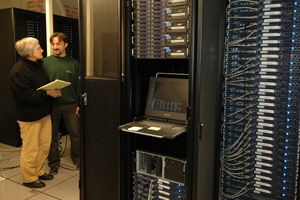
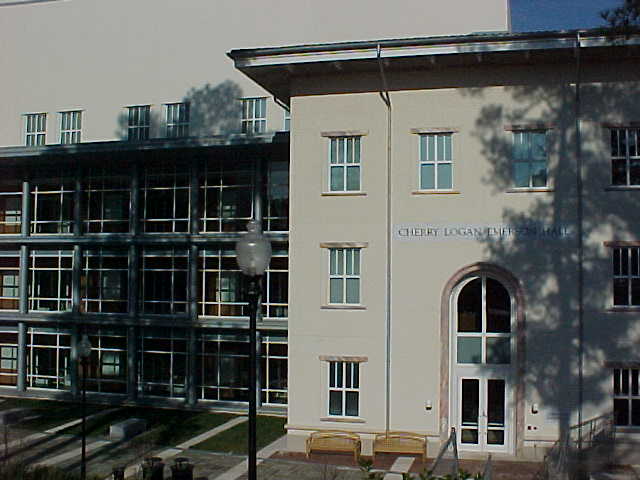
The Center is housed on the fifth floor of the Cherry Logan Emerson Hall. Currently, it owns, maintains and operates:

  1. SUN Fire v20z Linux cluster with 26 dual 2.2GHz nodes: 2GB RAM, 73GB disk
  2. Two IBM SP supercomputers including (a) 15 SMP type of nodes with 58 CPU's, 3.2GB RAM and 540 GB hard-disks, and (b) 14 thin nodes with 14 CPU's, 4.0GB RAM and 100 GB hard-disks;
  3. 5 IBM RS/6000 server workstations; and
  4. Origin-3200, and three Octane_2 with two processors and V10-graphic cards each.

The above equipment are all connected by fast ethernet. In addition, the Center maintains and provides service to more than 30 state-of-the-art application programs, including:

  1. Electronic structure codes such as Gaussian, Molpro, Aces_II, Gamess-US, Dalton etc.;
  2. Biomolecular modeling and visualization codes such as Amber, Sybyl, MacroModel, Molden, Mathematica, Matlab, etc.;
  3. Popular databases such as QCLDB, MDL and Cambridge Crystallographic Database.

In addition, the latest versions of all system software, compiles (Fortran, C, C++, Java etc.) and libraries (ESSL, PSSP etc.) are available to our users.

short courses emory university shield
faqs
points of interest
search

About Us | Center Subscription | Visiting Fellows | Lectureship Award | Research | User Handbooks | News | Center Homepage

Short Courses | FAQs | Points of Interest | Search | Emory College | Emory University


Emory University